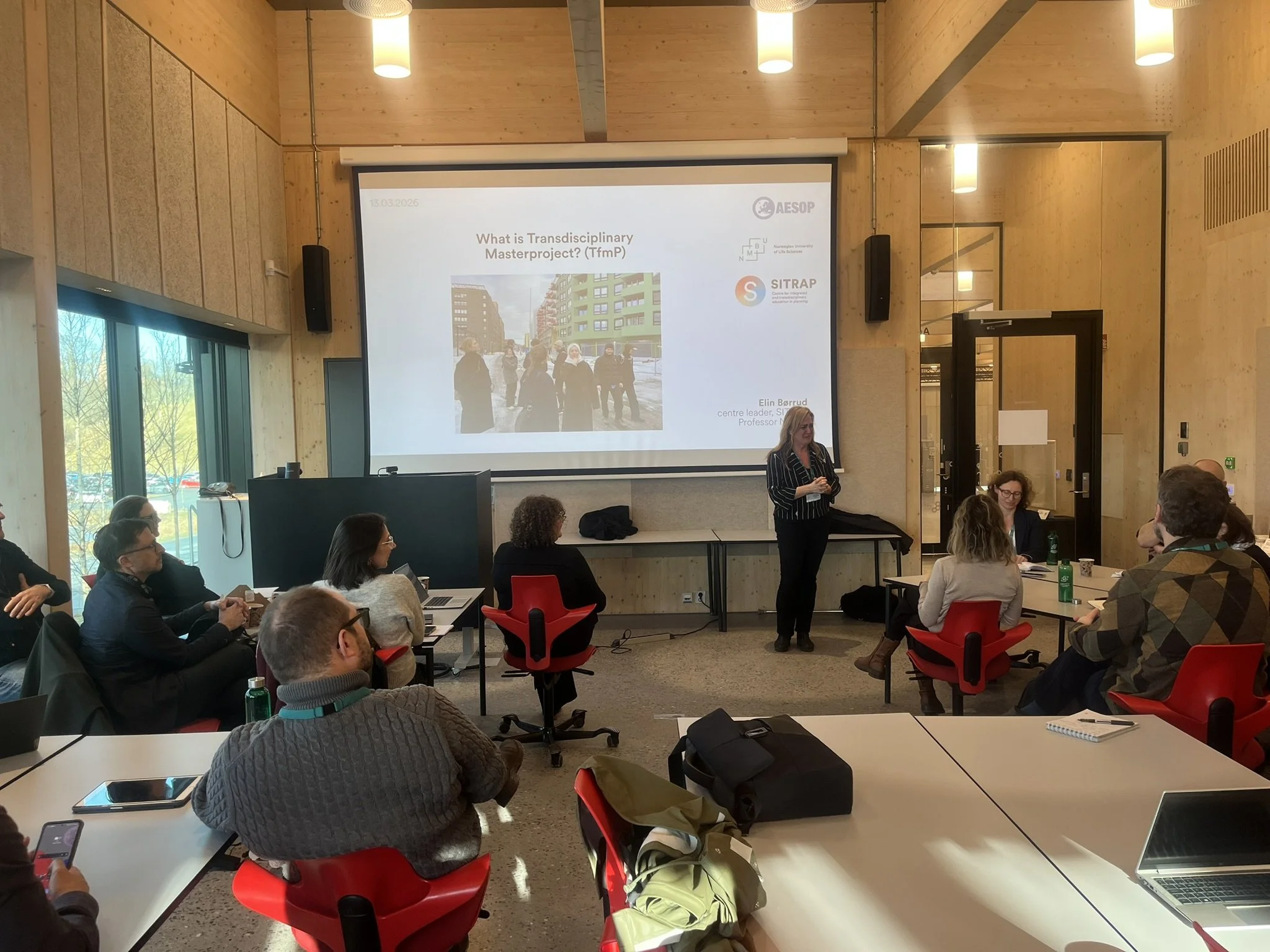
A workshop was conducted at the AESOP Head of School Conference to present and reflect on the development of the Transdisciplinary Master Project (TfmP) at NMBU. The session examined how the learning arena has evolved between 2023 and 2026, explored patterns in student participation and knowledge production, and discussed the role of interdisciplinarity and transdisciplinarity in master's education.
Key findings
The TfmP brought together students and supervisors around shared cases and themes, facilitating collective learning while maintaining individual master theses.
Participation expanded across several study programmes and four faculties, although Landscape Architecture, Urban and Regional Planning, and Property Development remained the dominant disciplines.
The programme contributed to the gradual development of thematic knowledge banks, particularly within ecological topics related to the Oslo Fjord case. Research progressed from baseline diagnostics to intervention studies, advanced laboratory methods, and governance perspectives.
Document analysis, interviews, field inspections, case studies, and spatial analysis emerged as the most frequently applied methods, reflecting both general social science approaches and methods specific to spatial planning.
The analysis highlighted the challenge of assessing interdisciplinary impact and understanding how topics evolve, stagnate, and influence subsequent cohorts of students.
Workshop
The workshop focused on the role and format of the master's thesis, the balance between thesis product and learning process, methodological patterns in spatial planning research, and the evolution of themes and topics across student cohorts. Discussions also addressed how interdisciplinary and transdisciplinary collaboration may shape knowledge production and professional learning.
AESOP (Association of European Schools of Planning) is the leading international network of planning schools and researchers in Europe. It promotes education, research, and professional exchange in spatial and urban planning through conferences, thematic groups, publications, and collaboration among universities. AESOP serves as an important forum for discussing contemporary challenges and advances in planning theory and practice.
-
-
February - August.
